"Again," Mireille said. "And this time lead with the head."
Charlie began, and made sure to lead with his head.
He came out of the preparation with his weight already shifting, the spot picked on the far mirror before his body started moving, and he turned, his chin whipping around ahead of his shoulders to find the spot again and snapping back to it, the gold of his hair flying wide and catching up a beat late. He hit the end of the diagonal and snapped to a stop, square, set, one foot crossed behind the other and the chin up and the smile already there, the open delighted ta-da of it that she had also drilled into him, because a thing wasn't finished, she said, until you sold it being finished. Three weeks ago he'd have called this showing off and meant it as an insult. Now his body just did it.
In the mirror along the far wall a girl stood there panting lightly at the end of a diagonal, flushed and bright with effort. Her unitard was the color of marigold, one seamless piece poured over her from the high scooped throat to the ankle, a thin line of crystal worked along her curves that flashed when she breathed. It fit the way everything fit now, which was exactly, taking the full curve of him at the chest, drawing in tight at the waist, going out again over the hips and down the long line of his legs, and there was not one inch of it built to hide anything. He'd stopped expecting it to. The voice in his head, who had spent three weeks dancing along with him in the studio and decided she liked it here, looked at the clean line of him in the glass and said okay we totally nailed that, and he didn't have the breath to spare to push her back down.
Mireille was new, in the scheme of things. Three weeks new. Connie had stood at the front of the bedroom one morning and explained the change to the days with the warm sorry-not-sorry brightness she explained everything in. The mornings would stay hers: she would continue their education in makeup and hair and clothes and deportment, the small endless grammar of being a lady. The things Connie called girl skills, how to do another girl's hair, how to paint another girl's nails, how to talk while you do it, the weightless back-and-forth of feminine existence.
But the afternoons wanted more than she had to give. "I'm a generalist, my dears," she'd said, almost modest about it. "I can teach you to be young ladies. I can't make you exceptional ones. For that we bring in people who know."
So the shape of the days had hardened. Six of them, six rooms down the same wing, six specialists, each one paid a great deal of money to take one of them and drill, alone, in the single thing that had been chosen for each of them. They went in together after lunch and came out together before dinner, and in between, the wing filled with the sounds of it through the walls — somewhere the pock of a tennis ball struck clean and returned, somewhere a whistle, somewhere music starting and stopping and starting again — six girls being made good at six things none of them had picked.
"You have a body that wants to dance," Mireille said, walking the line of Charlie’s arm with two fingers, lifting the elbow a degree. "This is rare.” She’d said it like a compliment, which is what it was, and she had no idea she was describing a crime.
He'd tried to tell her. On the second day, once his hands stopped shaking and his head cleared enough to try anything. He'd waited until it was just the two of them and the mirror and he'd dropped the bright voice as low as it would go and said it plain: I need you to listen to me. My name is Charlie Wright. I'm nineteen. I'm a man. I was kidnapped. They did this to me, all of this, I didn't choose any of it, please tell someone. It had come out lifting and bubbling at the end like the best news of her week, please tell someone arriving like a question, but the words were the words, and should’ve been enough.
Mirelle had crouched to his level, kind, sorry, and told him they'd warned her the girls in the program sometimes said things like this. The acting-out. Very common. He was safe here, chérie, and working so hard, and that was all she was here for. And there was the trap, neat as everything else in this place: she believed him completely, and it slid right off her, because she'd been handed a story with a slot in it shaped exactly like the truth. A private program. Troubled young women, the discreet kind, with families who paid to have them looked after far from anywhere. The harder he meant it, the better it fit.
Over the weeks, they'd all tried, every one of them, and every one had hit the same soft paid-for wall.
So now he danced, and got better, because it was the only answer Mireille would take.
"That's our time." She checked the clock and looked him over once, head to heels. "Good work today. You should be proud of yourself."
And the green came on proud, small and sourceless and unearned, blooming up out of the center of his chest before he could get a hand in front of it. The soft electrochemical glow they'd built into him to reward exactly this, being good, being praised, being told he was a pleasure. He sat down on the floor to fold over his own legs into the long stretch, his forehead going down toward his shins with a flexibility he'd never had and never asked for, and he let the warmth wash through him and hated it and breathed, the way he'd learned to do with all of it.
"They'll come for you in a minute," she said, and gathered her bag. “See you tomorrow.”
The Warden walked him back.
That was Charlie's private name for the sour young man who moved them between the rooms and never once spoke, who existed, as far as Charlie could tell, only so that no two specialists ever met in a hallway and got to comparing notes. He fell in behind Charlie now and steered him down the carpeted corridor toward the bedroom with a hand he never quite used, and they hadn't gone twenty feet before another door opened ahead and Hal came out into the hall looking like the front of a casino.
Hal’s specialist — a relentlessly cheerful middle-aged woman named Tammi with an i — had decreed the first day that Hal would learn to twirl, and would do it in proper uniform. Today’s selection was a sleeveless leotard worked all over in pale crystal and silver beading that threw light in every direction at once, sheer mesh let into the chest and the flanks so the suggestion of him glimmered through the glitter, every rhinestone a small bright insult. He held a baton in one hand, carried the way you'd carry something you'd been ordered to keep and intended someday to make somebody eat.
Hal fell into step with Charlie. "How was the bopping," he said, sweet as tea.
"We literally did the head thing for an hour. My neck's gonna come clean off." Charlie tipped his chin at the baton. "How was — that."
"Today we worked on the flash. The flash. Like Ah’m standin’ on a field in front of a marchin' band lookin’ like a disco ball in an outfit cut up to here, smilin' till my face cramps, throwin' a metal stick in the air. There is no version of that anybody respects. It is the single most useless thing one human bein' can be made good at." He tossed the baton — a lazy contemptuous flip, no height to it — and caught it without looking, the catch landing in his palm with a soft expert smack, and his whole face had murder in it. "There. See that? Ah hate that Ah can do that. Ah hate it down to the ground."
A second door opened, and Peter emerged, and the contrast of the three of them strung down the hall was a joke the universe was telling at their expense. Peter came out sweat-dark and flushed in a practice kit: sports bra and high waisted compression shorts, every line of the lean hard new body on open show, the flat stomach, the long muscled legs, the small firm chest the bra flattened and lifted at once, and a lacrosse stick over one shoulder with the netted head riding up behind him. The chestnut was scraped back in its ponytail, and he walked like he was looking for something to check into the boards.
"They had me running the wall drill till I dropped," he said, by way of hello, the broad Boston flat and disgusted. "An' the wuhst paht? I'm good at it now. I caught everything. I wanted to catch everything." He shifted the stick. "It's the wanting I can't stand."
"Least you get to run around and hit people. Ah get spangles," Hal said.
And Porter, last, unhurried, the way Porter did everything, stepped out of the final door in tennis whites, a sleeveless white collared top and a little pleated white skirt that flicked when he moved, the dark-blonde sheet of his hair pulled into a low tail with not one strand loose, the racket carried easy in one hand. He had not, Charlie was fairly sure, broken a sweat. Porter didn't so much play tennis as administer it. His cool grey eyes did a single circuit of the other three, taking inventory, and he fell in at the head of them without being asked, and the four of them went down the last of the hall together, herded, in their costumes, toward the painted-flower door.
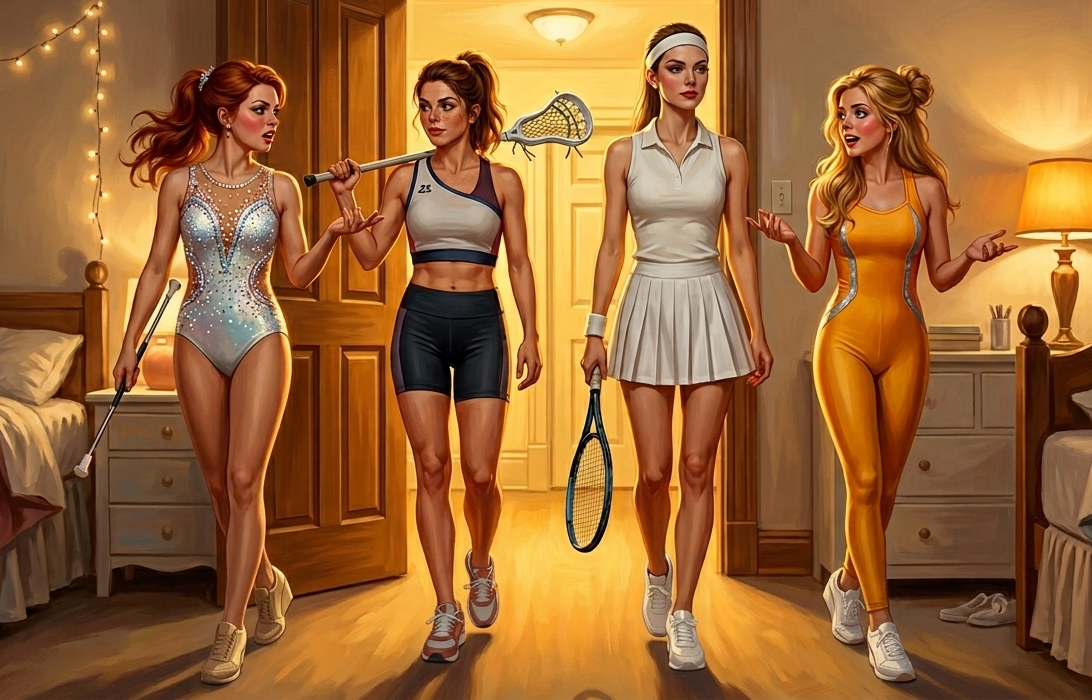
"Anyone actually struggling with theirs?" Porter asked, low, placeless and even. "Or are we all quietly turning out competent."
That was the thing none of them quite said out loud, the thing that sat under the whole arrangement: they were getting good. Not gifted. Nobody was bound for a stage or a tour or the US Open.The dancing was the dancing of a girl who'd had years of lessons, no more, Porter's tennis a good club player's, Peter's lacrosse a solid roster girl's, and that was the point. Believable. The kind of skill that said she's done this since she was small.
Porter pushed the door open and they went through, and Jay and Austin were already back.
Jay was sprawled on his bed with one knee up, a pair of big padded studio headphones pushed back around his neck, a flat little controller pad in his lap, his fingers moving on it light and fast, not playing so much as fidgeting the way another person taps a pen. The great dark cloud of his hair was banded back off his face and still took up half the headboard.
"There she is," he said to Charlie, grinning, all warmth in it, and three weeks ago that there she is would have gone through Charlie like a spike and now it just landed, because that fight was over and had been over for weeks. "How was the bopping."
"Omigod, why does everyone keep saying bopping."
"'Cause it winds you up." Jay tapped out a little run on the pad. "Got told my hi-hat drags today. Hate that I now know what that means."
"At least yours is useful," Austin said.
It came out small and breathy and exact, the spun-glass voice, from where Austin sat very upright at the foot of his own bed. He had a stack of glossy magazines beside him and a tray of little jars and bottles in front of him and an open notebook in his lap, and he was working — that was the only word for it, the careful hunched attention of a kid at a hard problem set. The fashion man had him studying.
Charlie had gathered the shape of it over the weeks: Austin didn't know any of this, hadn't ever cared about a serum or a silhouette in his life, and so they made him learn it, drilled him on it, ingredient lists and brand houses and the order you layered a routine and the names of cuts and fabrics and seasons, quizzed him cold and sent him back to the magazines when he missed, an encyclopedia being loaded into him one entry at a time. He had a jar in his hand now and was copying the back of it word for word into the notebook, lips moving.
"At least DJing is an actual thing. They’ve got me memorizing eyeshadow palettes." A tiny pause. "He's not wrong about your hi-hat, though."
"Oi." But Jay was laughing. "Even the quiet one's got notes."
Charlie sat down on the end of his own bed and watched Austin study, and it landed worse than if Austin had been good at it. He was so plainly not. Every line copied out longhand, every brand name sounded out in Korean, a boy memorizing a stranger's expertise the way you'd cram for a final in a subject you hated, because somewhere there was a quiz coming and if he failed it the circuits would be waiting with their red reprimand.
"They started me talking to the camera today," Austin said, into the quiet, and the glass voice had gone thin. "Just — practicing. How you look into the camera. How you say hi guys." He set the jar down very precisely. "I have to do an unboxing tomorrow. I have to open a box on camera and be excited about what's in it." He looked at the notebook, not at any of them. "I don't know what's in it. I don’t care what’s in it. But you have to be surprised." The smallest breath. "I've been practicing being surprised."
"They're makin' our Austin into a little influencer," Hal said, lowering himself onto his bed with the baton across his knees, Georgia laid thick over the blade of it. "Teachin' a stolen child to squeal hi guys and gasp at a box on cue. Bless his heart. Bless all our hearts, really. We are gonna be the most darlin' little nightmares."
"You know what does my ‘ead in, though." Jay wasn't really asking, his fingers still moving on the pad in his lap, his eyes somewhere on the ceiling. "Not that they're givin' us things to do. It's which. They've gone an' made us bloody stereotypes. Look at it. They give the Black girl —" a flat gesture at himself — "the decks. Music's in the blood, innit, that's what they reckoned, didn't even ‘ave to fink about it. Hal's now some —" he glanced at the spangled leotard — "some shiny Southern bird in a swimsuit?"
“That’s not —” Hal started.
“Ain’t it, though? Austin's studyin' K-beauty? Din't even bother bein' original about it. Just reached in the drawer an' pulled out whatever the box said we should be." His eyes came across the room and found Charlie and stalled out cold. "An' Charlie’s —"
"The dumb blonde," Charlie said after an uncomfortable moment. “It’s okay. I'm the dumb blonde, omigod, I dance and I'm happy and I don't think about anything." The dimples came in on their own. "Easiest one in the drawer."
Nobody laughed. Jay had already looked away. The joke hung there with nowhere to go, and Charlie let it drop, because somewhere in the last weeks it had stopped being a costume he was kidding about.
"Twenty minutes to dinner," Porter said, into the silence, in the voice that ended things. He was already moving toward the bathroom corridor, the queen bee adjourning a meeting nobody could stand to sit in. "We should clean up. Some of us smell like a field." A flick of grey eyes at Peter.
In the bathroom, Charlie stripped the unitard off, peeling it down inside out the way you peeled off a wet swimsuit, and stepped into a stall, and washed. The first days in here had been unbearable, soaping a body that announced itself at every inch, every new curve and soft stretch of skin reporting back under his hands like an alarm that wouldn't stop, this is yours now, and this, and this, until he'd come out shaking. But a person got used to anything, apparently, even this. The body had stopped being news. His hands moved over it without flinching, over the dip of the waist and the swell of the hip and the long smooth legs, and registered almost nothing, the way your hands don't really feel the dishes anymore after enough of them. It had gone rote. He could wash himself now thinking about something else entirely.
Except at the chest, where his hands slowed, because they had to.
The breasts had never sanded down the way the rest of him had. He'd waited for them to, the way the waist and the hips had gone quiet, and they never did, because they were sensitive. Wired, awake, the skin of them tender to the lightest pass and the nipples worse, drawing tight under the cool water. Washing them meant taking the soft heavy weight in one palm and running the cloth over skin that lit up at the contact, the slick lather sliding, a low warmth pooling and spreading whether he wanted it or not. It always felt good. That was the part he couldn't make peace with, his own body purring under his own hand, a dull reliable pleasure rising through the necessary daily half-minute of it.
The hair was the real labor. He'd learned the hard way that you didn't just wash it, you managed it, you worked the shampoo down its whole length in sections, rinsed until the water ran clear or it would itch all night, dragged the conditioner through from the ears down and never the scalp, and then wrung it out in a heavy rope that dripped down his spine no matter how he twisted it. Twenty minutes of his life, every day, to a thing on his head he hadn't asked for. He was learning to hate it the way you hate a needy pet.
"Anyone else's coach get handsy with the postyuh corrections," Peter said, from two stalls down, voice raising over the water. "Mine's got opinions about my core engagement."
"Omigod, mine literally will not stop touching my hips," Charlie called back. "Like every two seconds, to 'find my center.'"
"They all do it." Hal, somewhere to his left, sweet through the spray. "Get used to bein' handled. We're livestock now. They check the livestock."
The running water was good cover, and they used it, six voices loose and ugly and theirs, bouncing off the tile, saying the things they'd never say at the table, while the steam climbed and the stalls hissed and nobody, for a few minutes, had to be lovely about anything.
"You know what we ah? We're show ponies," Peter said as he turned off the water. "Six show ponies in a little gold bahn, and that man's gonna trot us out one day, and we're gonna pehfawm, and everybody's gonna clap. Best in show. Every single one of us."
Hal laughed — the bright chiming thing, bitten short — and said, "Trot us out, Lord, that's grim," and Jay said "shut up, both of you," not meaning it, and the moment passed, and they dried off and dressed and went in to dinner.
Dinner was the same every day. The long wooden table, the real plates, the small careful portions that Connie called a meal and the eye called a garnish. Connie at the head in her silver chignon, serene, presiding, asking each of them in turn about her afternoon and listening to the answers with her whole warm face, the way a mother listens, the way the circuits had taught all six of them to need to be listened to.
And on the sideboard, the Goo always lurked.
Six dispensers, standing at attention in their warming cradles, the obscene tray of them that had stopped being a shock weeks ago and become, instead, furniture. Permanent furniture. Connie had never mentioned them again, not once since the night she'd lifted the cover. They were simply present at every meal now, warm and ready, six of them for six of them, and at every meal no one had any, and the not-having had worn itself smooth into the grain of the evening.
Charlie had stopped having to fight it the way he'd fought it that first night. That was the thing he let himself be quietly, privately proud of, sitting there cutting a single small medallion of chicken into smaller pieces. The want hadn't gone. He'd been wrong to hope it would. It still sat behind his sternum, but it had flattened. That first night it had been agony, a live thing leaning down the dark hall toward the dining room, loud enough to keep him awake.
Now it was an ache. A dull, constant, carried thing, the weight of an old injury that no longer stopped you doing anything, only reminded you, at quiet moments, that it was there. The body had stopped screaming for the Goo and settled into merely missing it, the way you miss a thing forever instead of all at once, and the missing had become so ordinary that he could sit a foot from the warm cradles and feel only the low steady hum of it and finish his sentence.
But the best part — the part he turned over now, cutting another small neat trained bite of chicken he didn't especially want — was Vane.
Because it was killing Vane. Charlie was sure of it. Vane came by the dining room sometimes, at the start or the end of a meal, and his eyes always went, first thing, to the cradles. To the full untouched cradles. And over the weeks Charlie had watched something happen in the man's face that happened nowhere else, a tightness, a flat little downward thing at the corner of the mouth, the look of a man whose model was off by a value he couldn't find.
Whatever the Goo was for, they were behind schedule on it, and the thing that was holding the schedule up was six kidnapped kids deciding, three times a day, to be hungry instead. It drove Vane quietly up the wall. Charlie could see it. And Charlie loved it. Every full cradle was a small flat no aimed straight at the one man in the building who thought he'd accounted for everything, and Charlie ate his small bites and watched Vane's jaw tighten and felt, for the length of a meal, like he was winning something.
"—Mireille tells me you're coming along beautifully," Connie was saying to Charlie, beaming down the table at him, and the green stirred at beautifully and he let it, half-listening. "She says your turns have gotten ever so clean. I'm not surprised." She took a small sip of water. "She did mention you can be a touch dramatic when you don't get a thing right away. A little theatrical." A fond little laugh. "I told her, well, that's just our Charlie. Such a performer."
"I'm not dramatic," Charlie said, which was, he heard a half-second too late, a fairly dramatic thing to say, and Jay snorted, and Connie's eyes crinkled.
"Of course not, dear." She set the glass down and looked around at the six of them with the satisfied warmth of a woman surveying a table that was, by her lights, going very well. "You know, I do think you've all settled in so nicely these past weeks. It does my heart good. When I think how frightened you all were at the start." She shook her head gently. "And now look. Six accomplished young ladies, each so good at her own thing. My little show ponies."
The table went still.
Not dramatically. Nothing fell. Connie didn't even notice. She'd said it the way you say a thing you've heard somewhere and liked the sound of, sweetly, fondly, already moving on, already asking whether anyone wanted more of the green beans, entirely innocent of what had just gone through six people at the same instant like a current through wire.
Charlie's fork had stopped a half-inch off his plate.
Show ponies.
He did not look up. That was the only thing he got right in that first second, the one piece of him that kept its head. He did not look up, did not jerk his eyes to the others, did not do the single most natural and most ruinous thing a person could do, which was check whether everyone else had heard it too. He kept his eyes on his plate and his face on nothing and he held the fork where it was and he felt the bottom go out of the warm room.
Show ponies. Peter had said that exact phrasetwenty minutes ago, in the shower, with nobody in the room but the six of them, meant for no one, and Connie had just set it down on the dinner table. There was no road from that shower to this table that did not run through a microphone.
Charlie made himself take the bite. He put the fork in his mouth and he chewed the small neat trained bite and he swallowed it down past the place where his heart was now living and he reached for his water and he drank, and across the table, in the edge of his vision where he didn't dare aim it, he could feel the others doing the same thing, the same held nothing, six people performing eating-dinner while the floor fell out from under all of them at once.
He'd been so stupid. That was the thing rising hot through the cold, almost worse than the fear. All of them had. They'd showered and felt private, and they had a whole catalog of moments like it — the bathroom, the late nights, the small unguarded asides — places they'd quietly decided were theirs, off the record, safe, and they'd built the whole catalog on nothing but the warmth of the carpet and the kindly face at the head of the table. Of course they were listening. You did not spend a man's fortune building six people from scratch and then leave the room when they thought you weren't there.
The concrete cell had told the truth about itself, bare and watched, and they'd guarded their mouths in it without being told. Then they'd been moved somewhere that looked like a home, and the comfort had done in ten weeks what the concrete couldn't: made them careless.
Every joke. Every half-plan, every late-night murmur about doors and windows. Every sweet poisoned jab of Hal's, every scared small thing Austin had breathed into the dark. All of it filed, all of it heard, and Connie, who maybe knew exactly what she'd done and maybe truly didn't, had just handed one back across the table as an endearment without the faintest idea she'd done it.
Charlie got through the rest of dinner. They all did. Nobody said a wrong thing, because there were, he now understood, no places left to say a wrong thing, and the silence that settled over the back half of the meal was a new kind of silence, thick and aware, six people who had just learned the walls had ears performing for the walls so well that Connie, at the head of the table, only noticed they'd gone a little quiet and put it down to a long day, and told them, warmly, that they'd all earned an early night.
It was Hal who started it, that night, in the dark, after the lamps went down to their dim evening wash and Connie had said sleep well, my good girls and gone, and the room had lain for a long while in the awful new awareness of itself, nobody sleeping, nobody daring to speak.
Charlie was lying on his back, his eyes open, the gold hair spread out around him on the pillow, running the dinner again and again and getting nowhere, when something moved at the edge of his sight. Hal, in the next bed, propped on one elbow, and his free hand was up off the blanket and moving, held low in the band of dark the lamp didn't reach, just at the edge of where Charlie could make it out at all.
A flat hand, drawn once across, low, side to side. Quiet. Then two fingers tapped the side of his own head, then pointed at the ceiling, at the walls, all around. Then both hands came up, palms out, and pressed slowly downward, a thing that didn't need translating in any language: they're listening. Quiet. From now on.
It came back to Charlie all at once, the whole of it, the way a smell brings back a memory: they had a language. They'd built it once, under worse conditions than this. The masks. The long silent days when none of them had a voice and they'd built one anyway out of nothing, out of need, a flat hand for Connie's coming, two fingers turned over for your turn, all of it. They'd let it go when the masks came off and the voices came back, dropped it the way you drop crutches when the leg heals, because why sign when you could talk —
— and now talking was the one thing they couldn't do.
Charlie brought his own hand up off the blanket and kept it low, down in the dark below the lamp where Hal's had been, and understood as he did it why Hal had put it there. The lamps never went all the way down. There was always this last dim wash burning, low enough to sleep by and no lower, the least a camera needed to see by, and the shadows their bodies cast were the one corner of the house where cameras couldn't follow them.
He signed the old sign into it, the head-tilt-and-flick, the one about Vane, except he aimed it at the wall, at the whole watching house, and in the next bed he saw Hal's impossibly perfect teeth flash white in the dark, a real grin, the first real thing anyone had done since my little show ponies, and across the room, on the far beds, two more pale hands came up just below the glow and answered, and Charlie understood the room had just, silently, in the dark, agreed on something.
That first night they had almost no words. The old pidgin was a handful of signs, nowhere near enough to carry a real thought. But they didn't need it to be enough, not yet, because the thing that passed between the beds that night wasn't a plan. It was all of them telling each other they were, finally, awake.
Because Charlie realized that’s what Connie’s slip had actually done. It had woken him up. The mornings with Connie and the afternoons getting good and the green blooming warm in his chest every time someone told him he was a pleasure. The whole soft machine of the days had been quietly putting him to sleep for weeks, sanding the fight out of him a comfortable inch at a time, and he'd let it, they'd all let it, six prisoners getting cozy. My little show ponies had ripped the warm blanket off all at once and left him lying there cold and clear-eyed and ashamed, looking straight at the camera he'd been smiling for.
And he could see, from the hands moving in the dark, that the same thing had happened in every bed in the room. Nobody could say much. But the head-tilts and flat-palm flicks going back and forth were alive, a current running bed to bed, and the meaning underneath them needed no vocabulary at all: we're getting out of here.
It was a resolve before it was a plan, and it would have to wait on the language to become one. But the resolve came that night, whole, the moment the blanket came off.
The next weeks went into it. On the surface, nothing changed, six accomplished young ladies settling in beautifully, going to their mornings with Connie and their afternoons with the specialists and their three declined meals, talking out loud about the things that were safe to say out loud. Underneath, in the hands, a second conversation ran the whole time and grew, faster than the first because they had its bones already and because now they had a reason.
A whole grammar came up: signs for Connie and Vane and Cade, for door and window and outside and help, a sign for the Goo so crude it made Jay's shoulders shake the first time Hal deployed it across the breakfast table while sweetly requesting a little more fruit. They learned to do it low, in laps, against thighs, a flicker that read as a fidget if it read as anything, and to talk and sign at once, the mouth running harmless patter while the hands carried the freight. It was clumsy at first, the two channels tripping each other. And then, somewhere in those weeks, it wasn't. There came an ordinary lunch when Charlie realized he'd just held a whole silent exchange with Porter about the Warden — while keeping up an out-loud commentary on last night's rom-com — without once having to stop and think in either channel. Two rivers, side by side, neither in the other's way.
It was the one fluency in the building that hadn't been drilled into him with a current. The one thing they'd chosen. And that made it the only thing his new body could do that he was glad of.
The slumber party was Connie's idea, which was the joke of it, and the trap of it, and in the end the cover for it, though she would never in her life know that.
She announced it at breakfast a few weeks later, pleased as anything. "I've been thinking," she said, "that we ought to do something fun. A proper girls' night. A slumber party." She'd actually clasped her hands. "Every girl should have them, you know, the staying up, the doing each other's hair, the silly films and the talk. It's part of it. It's part of the whole — fabric, of being girls together." She'd looked around at them, warm and certain and entirely sincere, a woman offering them a piece of a childhood none of them had had or wanted.
The lovely things were waiting on the beds that evening: nighties, soft and short and sleeveless, a different one for each of them in a different sweet color, sheer at the wrong places and trimmed in lace and ribbon, the kind of thing that existed for no reason on earth except to be looked at. Charlie winced when he picked his up, a sheer baby-pink thing, a little sleeveless babydoll top of pale gauze that ended at the hip over matching briefs, the front tied with a small satin bow, the fabric so fine it hid nothing, his soft new curves plainly readable through it, and he'd looked at himself in it and felt the familiar lurch and then put it on, because the alternative was an argument the walls would hear.
They hated it. All of it. They told each other so in the hands while Connie set out nail polish and face masks and a bowl of popcorn and put a rom-com on low and told them she'd leave them to it, that this was theirs, a night just for the girls, and shut the door.
And then, when she was gone, the six of them looked at each other across the warm room in their soft short sheer ridiculous nighties, and the hands started moving, and the slumber party began for real.
It looked, from the outside, like exactly what Connie had ordered.
Hal had claimed the bed by the lamp and was doing Charlie's nails, because Hal had turned out to be alarmingly good at it, and he held Charlie's hand flat in his own and laid the color down in clean confident strokes, the auburn falling forward over the wine-dark slip of a nightie he'd been given, the lace strap sliding off one shoulder and pushed back up and sliding again. He was talking the whole time, sweet and loud, gossiping out loud about a thing on the rom-com, would you look at her shoes, sugar, in the snow, who let her, his honeyed voice carrying easily to whatever was listening.
And under it, in the hand that wasn't painting, against the blanket where the lamp didn't reach, Hal was saying something else entirely.
He tilted his head back toward the activity wing — their route, their hall — and walked two fingers along the blanket, slow, counting. Stopped them at the end. Both palms pressed together, then pulled apart: door. Then he let one hand go heavy and resistant against the other, pushing through reluctant air. Heavy.
Charlie, his free hand low against his thigh, pointed past Hal, a question: past it? Then spread his palm face-up: what.
Hal's fingers turned over. Don't know. Aloud: "Other hand, sugar, hold still, you'll smudge."
Across the room it was, to any watcher, a portrait of the thing Connie had wanted to give them. Jay sat on a bed, the green nightie he'd been handed — a deep emerald slip, sheer, the lace of it dark against the warm brown of him — pooled around his thighs, the great cloud of his hair freed from its band and standing out around the lovely broad-cheeked face, and he was doing the talking now, big and warm, narrating the film, nah he's gonna leave her, watch, he's gonna be a right arsehole. Peter sat near him in an oversized white mesh jersey and boyshort panties, his bare legs stretched out long in front of him, the chestnut down for once and brushed out around the freckled face, and he was eating popcorn one piece at a time and putting in the flat dry asides that made Jay lose it, bet you a week's yoghuht she trips on the escalatah, and it looked, it absolutely looked, like two friends watching a movie.
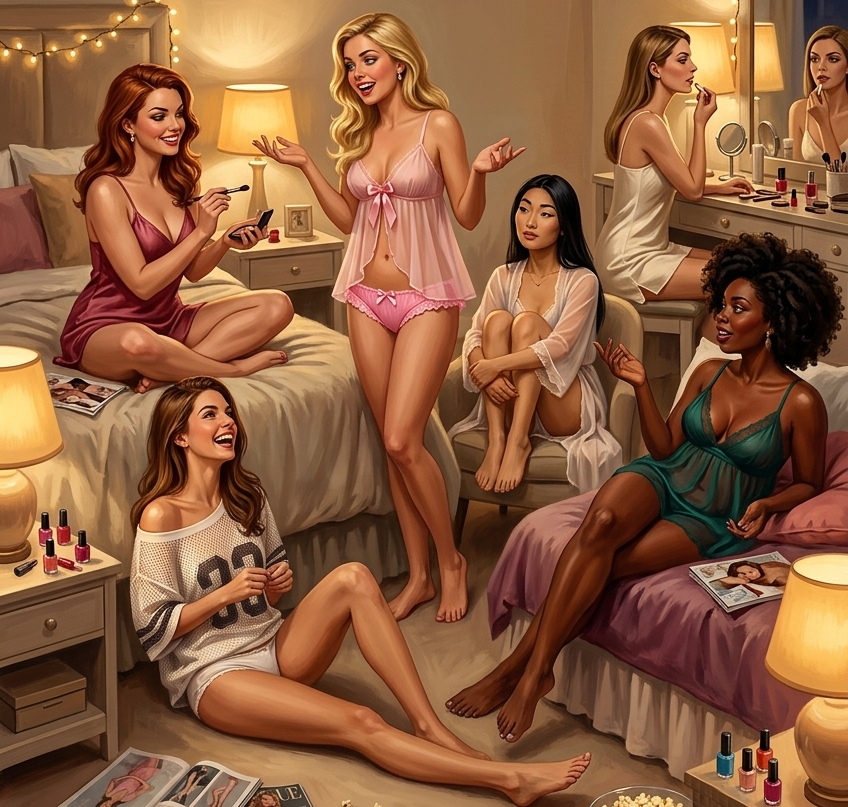
And under it, in the hands, against the floor, in the dark between them, Jay's fingers were laying out for Peter everything he'd been able to see of the route from his music room to the bedroom, and Peter was taking it in, nodding at the film, saying told you so, and signing back the lacrosse route, the doors he knew, the one stairwell, mapping the house a fragment at a time, each of them holding one tile of it, the picture assembling, a point at a time, into something whole.
It was Peter who signed the thing they all worried about. He touched his own temple — the nodes — then made the flat downward press they used for they're listening, except aimed inward. The room understood. The circuits. The thing that had frozen Austin to the floor of the concrete room. Even with a route, even with a door, Vane had a button.
Austin was shaking his head, and his hands were moving. The boots, he signed, and tapped his own delicate bare ankle below the hem of the slip, where the stride-locking boot used to sit and didn't now. The boots were gone, traded weeks ago for kitten heels and painted toenails. It was a thin hope, that Vane’s button required the boots to freeze them. Charlie could see the doubt pass through each of their faces in turn, and then the hope won out, because the alternative was to set it all down and go back to sleep.
Porter sat a little apart, at the vanity, where Charlie kept finding him in the mirror. He'd been given a slip of pale ivory silk, and he sat at the lit mirror with the cool composure he never put down, doing his own face with the unbothered competence of a woman who'd done it a thousand times, and he watched the whole room in the glass while he did it.
His hands, when they came down off his face, signed into the reflection where the others could read them. He walked two fingers along the vanity's edge — the route — then lifted them off the surface entirely and held them suspended, moving nowhere. His palm turned up. Then he touched his own eyes and shook his head once, and pointed outward, at the wall, at whatever was beyond it.
Route. Outside. Never seen.
That was the wall they kept hitting, every night, in the hands.
Charlie watched Austin, who'd been quiet. Austin was in a soft white robe over a little slip, sitting with his knees drawn up the way he sat, the black hair brushed to a shine, present tonight, his dark eyes moving among them. He lifted his small hands and signed it: one finger up, first, then the flat-palm press they used for stop flipped over, opened, released. The nearest thing the pidgin had to chance, and all of them understood it. Then the two-finger walk they'd started using for move, aimed at the wall.
First chance. Move.
A pause. On the television a woman ran through an airport. Jay laughed out loud at it, right on cue, the big warm laugh, perfect cover, and under the laugh his hands said yeah, and Peter's said yeah, and Hal finished Charlie's last nail and held the hand up to the lamp to check the line and said, aloud, sweet as tea, "There. Gorgeous. Look at you," and underneath, against the blanket, signed: Agreed. First chance. Move.
Charlie sat in the middle of it with his nails wet and his hair down and the sheer pink nothing of the nightie soft against him, the want humming low and held behind his sternum where it always was, and looked around the warm dim room at the five of them — Hal's auburn, Jay's cloud, Peter's freckles, Porter's grey eyes in the mirror, and Austin, back, fully present, with them — and felt the thing in his chest he'd stopped being able to name, because it no longer had a clean name.
Here was the truth he could not say out loud in any voice and would not have known how to sign: he was enjoying it.
Not the plan. The plan was terror, the only thing keeping any of them upright. But the rest of it — the lamp glow, the soft nightie, Hal's clever hands on his, the dumb movie and Jay's laugh and the six of them with their hair down — some traitor part of him, the bright golden part they'd built, was having a genuinely lovely time. The horror of that and the comfort of that had stopped being two feelings. They were one feeling now, braided too tight to get a fingernail between, and he'd given up trying to.
They did the whole night, and did it flawlessly: the hair, the nails, the green clay masks they laughed at, the woman on the screen getting the right man at the end, the popcorn in small trained bites, the gossip out loud in six wrong wonderful voices about nothing. A perfect girls' night for whoever was watching. And underneath it, never once breaking the surface, their hands kept building the way out, a map with a hole in the middle of it where the exit should be, and a vow to run for that hole the instant it showed. It wasn't a plan. It was barely a hope. It could get them caught, or worse than caught, and Charlie held onto it anyway, nails drying, hair down, the want humming, the language moving in his hands, and would not have set it down for anything in the world.
On the television the credits rolled. Hal reached over and turned the lamp down another notch, and aloud, sweet as tea, to the room and the walls and whoever was listening, he said, "Best night Ah've had in here, y'all. Genuinely."
And under the blanket, where the lamp didn't reach, where nothing reached, his hand said the real thing, and they all read it, and not one of their faces changed:
First chance. Move.