The late autumn air cut through Logan Turner’s jersey like a blade as he lined up for what would become the last play of his life as he knew it.
Twenty-two thousand fans packed Westlake Stadium, their voices creating a wall of sound that vibrated through his chest. Under the blazing Friday night lights, Logan felt invincible—six-foot-two of sculpted muscle and precision-honed instincts, the kind of wide receiver that NFL scouts drove hundreds of miles to watch.
He’d already broken the school record tonight. Fourteen touchdown catches in a single season, each one adding another layer to the legend he was building. His highlight reel played like poetry in motion—impossible one-handed grabs, acrobatic catches in double coverage, routes run with such precision that defensive backs looked foolish trying to match his cuts. The athletic department had made him the face of their recruitment materials. ESPN had featured him in their “Rising Stars” segment. His future seemed not just bright but incandescent.
“Turner! Eyes up!” The quarterback’s voice cut through the crowd noise during the huddle. “They’re gonna come after you hard. You ready?”
Logan grinned, that cocky smile that had become his trademark. “When am I not ready?”
The confidence wasn’t empty bravado. It was built on three years of dominance, of making the impossible look routine. Logan Turner caught everything—passes thrown behind him, balls tipped by defenders, even the prayers heaved up when plays broke down. His hands were magnetic, his body an instrument fine-tuned for athletic perfection.
As the team broke huddle, Logan jogged to his position, the familiar ritual of football flowing through him like muscle memory. The crowd noise faded to background static. The field narrowed to just him, the defender across from him, and the space between them that he would soon exploit. This was his domain, his kingdom, his identity distilled to its purest form.
The play call was simple: a crossing route designed to pick up the first down they needed to seal the victory. Logan had run it hundreds of times. In practice, it was automatic. In games, it was poetry.
At the snap, Logan exploded off the line of scrimmage, his cleats biting into the turf as he drove toward the linebacker assigned to cover him. The defender was good—a senior who’d made All-Conference the year before—but Logan had embarrassed better players. Three steps downfield, Logan planted his outside foot and cut across the formation, creating the separation that had made him legendary.
The ball was already in the air, a perfect spiral threading between two defenders. Logan’s hands were up, fingers spread, ready to secure another routine catch that would add to his mythology. In that suspended moment, with the ball rotating toward him and the crowd rising in anticipation, Logan Turner was exactly who he was meant to be.
He never saw the safety coming.
The hit arrived from his blind side like a freight train derailing—two hundred and ten pounds of muscle and momentum traveling at full speed, helmet leading, aimed with devastating precision at the small of Logan’s back. The impact drove his spine into compression, vertebrae crushing against each other with a sound like breaking kindling that somehow carried over the crowd noise.
In that microsecond of contact, Logan’s world exploded into white-hot agony that seemed to originate from his very core and radiate outward like shockwaves. Time stretched and warped as he felt his body fold at impossible angles, his legs suddenly disconnected from any conscious control. The football bounced harmlessly away, forgotten, as twenty-two thousand people fell silent so quickly that the absence of sound became its own deafening presence.
Logan hit the artificial turf face-first, his hands clawing at the synthetic grass as electricity shot down his legs and up into his skull in waves of nauseating pain. He tried to push himself up, tried to spring back to his feet the way he had thousands of times before, but his legs wouldn’t respond. Nothing below his waist responded. Panic crashed over him in suffocating waves as the terrible truth began to dawn—this wasn’t just pain, this was absence. A void where sensation should have been.
“Don’t move.” The team doctor’s voice seemed to come from very far away, filtered through layers of shock and disbelief. “Logan, can you hear me? Don’t try to move anything.”
“I can’t...” Logan’s voice cracked, the words barely escaping his throat. “I can’t feel my legs. I can’t feel anything.”
The stadium lights blazed down on him like interrogation lamps as the medical team surrounded him with urgent efficiency, their whispered consultations confirming what Logan’s body already knew with terrifying clarity. Somewhere in that collision of helmet against spine, in the physics of impact and the fragility of human anatomy, everything had changed irrevocably.
As they carefully strapped him to a backboard, Logan caught sight of the scoreboard through his peripheral vision. Third quarter, Westlake leading by fourteen. The kind of comfortable margin that usually meant he could coast through the final period, maybe add another touchdown to his statistics if the opportunity presented itself. Instead, he was being loaded into an ambulance while his teammates watched in stunned, helpless silence.
The diagnosis was catastrophic: three fractured vertebrae, severe nerve compression, and extensive soft tissue damage requiring surgical intervention. Logan heard only fragments of the doctor’s diagnosis through the fog of medication and disbelief—words like “compression” and “paralysis” and “permanent” that seemed to echo endlessly in the sterile hospital room.
As a junior who had been methodically building an impressive highlight reel for NFL scouts, watching his draft stock rise with each spectacular catch, Logan’s future collapsed overnight like a house of cards in a hurricane. The surgery would stabilize the vertebrae, but the compression damage to the spinal cord meant that football—the sport that had defined every aspect of his identity since childhood—was no longer a possibility. They would focus on preserving what function they could, on helping him adapt to a new reality that felt impossible to accept.
The first weeks after surgery passed in a blur of prescription painkillers and fitful sleep punctuated by visits from people who didn’t know what to say. His teammates stopped by initially, filling the hospital room with awkward small talk about the season continuing without him, but their discomfort was palpable. Logan had become a reminder of how quickly everything could disappear, a cautionary tale they’d rather not confront too directly.
By the time spring semester began, Logan was hobbling around campus with a back brace, the titanium rods in his spine a constant reminder of everything he’d lost. He watched his former teammates in off-season conditioning while he struggled through basic rehabilitation exercises that left him exhausted and frustrated. The explosive athleticism that had once felt like breathing now seemed as foreign as flight.
“We need to discuss your scholarship situation,” Coach Davis said during a meeting in early February, his expression grim as he closed his office door with the finality of a coffin lid. The conversation Logan had been dreading for months was finally happening.
Logan shifted uncomfortably in his seat, the back brace rigid beneath his Westlake hoodie—one of the few pieces of athletic gear he could still wear without feeling like a fraud. “The doctors say I could be moving normally again by summer.”
“Moving normally isn’t playing, Logan.” Coach Davis slid a document across the desk with obvious reluctance, the paper landing between them like a death certificate. “The medical staff believes you’re unlikely to return to competitive form by next season. Hell, they’re not sure you’ll ever return to competitive form.”
Logan felt his entire world shatter. “You’re cutting me?” he sputtered. Without his athletic scholarship, he couldn’t afford to continue his education. The degree in sports management that had seemed like natural preparation for a post-NFL career was now financially impossible.
“There has to be something you can do,” Logan pleaded, hating how his voice cracked with desperation. “I’ve given everything to this program for three years. Everything.”
“I wish there was,” Coach Davis replied, and the genuine regret in his voice made it somehow worse. “I fought for you, Logan. I really did. But that roster spot needs to go to someone who can contribute next season. All I can offer is to make some calls to smaller programs that might take a chance on you after rehabilitation, but...”
The unfinished sentence hung between them like a death knell. Logan Turner—the player coaches would have moved mountains to recruit just months ago—had become a liability, damaged goods that needed to be quietly discarded.
The remainder of the semester became a downward spiral with its own terrible momentum. Logan’s grades plummeted as depression settled over him like fog, thick and suffocating. He stopped attending classes altogether, missing assignments and failing midterms with the methodical precision of someone determined to destroy whatever remained of his future. His academic advisor placed him on academic probation, but Logan was too consumed by bitterness and self-pity to care about warnings and ultimatums.
He withdrew from team activities entirely, no longer able to bear watching his former position being filled during spring practices. The sight of another receiver running his routes, catching passes in the spots that had once been his territory, felt like watching someone else live his life. Physical therapy sessions became exercises in frustration as his back refused to heal at the rate he desperately needed, each small improvement feeling insignificant against the magnitude of what he’d lost.
By Spring Break, Logan was failing nearly all his courses, his GPA dropping well below the threshold required even for academic probation. The university had no choice but to dismiss him, the decision delivered with cold, bureaucratic efficiency. The official letter arrived without ceremony—effective immediately, Logan Turner was no longer a student at Westlake University.
With nowhere to go and no future to speak of, Logan spent what should have been the end of his junior year in a haze of bitterness and resentment. He watched from his depressing off-campus apartment as his former teammates posted training videos on social media, their feeds filled with motivational quotes about championship aspirations while he struggled just to stand without grimacing in pain.
The eviction notice arrived on a Tuesday in April. Logan stared at the official document through eyes blurred with exhaustion and something dangerously close to tears. Thirty days to vacate. The part-time job at the campus bookstore—one of the few places that would hire someone whose only qualification was “former football star dropout”—barely covered groceries, let alone rent. His credit cards were maxed out, his bank account overdrawn, and the handful of friends who hadn’t quietly distanced themselves after his fall from grace had stopped returning his calls weeks ago.
That night, Logan sat on the floor of his nearly empty apartment, surrounded by the detritus of his former life. Trophies he couldn’t bring himself to throw away but could no longer bear to look at. Team photos where his smile looked foreign, like it belonged to someone else entirely. A framed Sports Illustrated article about “Rising Stars” that now read like an obituary. His phone buzzed with another call from a debt collector, and he let it go to voicemail with all the others. Outside, he could hear students laughing as they walked back from bars he could no longer afford, living the college experience that had been ripped away from him.
The realization hit him with devastating clarity: he had become invisible, a ghost haunting the edges of a world that had once revolved around him. In thirty days, he would be homeless, with no family to turn to and no prospects beyond minimum-wage jobs that would barely keep him fed. The thought made his stomach turn with shame so profound it felt like drowning.
That’s when the unusual email arrived: “Gupta Injury Rehabilitation Lab Initiative.”
Logan almost deleted it as spam—his inbox had become a graveyard of false hopes and miracle cures that preyed on desperate athletes. But something about this message’s clinical tone caught his attention. Unlike the obviously fraudulent offers that cluttered his email, this seemed professional, almost academic in its approach. The sender, Dr. Gupta, claimed to represent a specialized program that helped injured athletes secure new athletic scholarships through what she called “alternative pathways.”
Her proposal was deliberately vague but tantalizingly promising—a summer-long “physical repatterning program” that would prepare him for “placement in a high-demand athletic position.” The language was clinical and precise, suggesting serious medical intervention rather than the snake oil that usually filled such offers.
With nothing to lose and nowhere left to fall, Logan replied to the email and scheduled a consultation at Dr. Gupta’s private clinic on the outskirts of town. If it turned out to be another dead end, at least he could say he’d tried everything.
The facility that housed the Gupta Injury Rehabilitation Lab Initiative was sleek and ultramodern, more resembling a high-tech research laboratory than a rehabilitation center. The building’s glass facade reflected the afternoon sky, while the interior visible through floor-to-ceiling windows suggested sophisticated equipment and pristine conditions that spoke of serious funding and cutting-edge technology.
Instead of the expected weight machines, resistance equipment, and therapy pools typical of sports medicine facilities, Logan was surprised to see mostly sterile examination rooms containing bizarre and futuristic-looking devices he couldn’t begin to identify. Large workout studios were filled with contraptions that resembled medieval torture devices more than rehabilitation equipment, their purpose completely unclear to his untrained eye.
Sitting in the lobby awaiting his appointment, Logan leafed through a glossy brochure that promised “proprietary methodology that transcends conventional physical therapy paradigms through neurological repatterning rather than muscular reconditioning.” The language was so dense with technical jargon that he could barely parse its meaning.
“Who even talks like that?” Logan thought to himself, wondering if the dense jargon was just pretentious marketing speak designed to impress desperate people like him.
He was about to find out, as Dr. Gupta herself emerged from the inner corridors to greet him. She was intimidating in person—tall and commanding, impeccably dressed, with calculating eyes that seemed to measure his every movement. But she had a tendency to speak in the same clinical technobabble that filled the brochure, as if she were translating her thoughts from some higher language into terms she hoped he might understand.
“Mr. Turner,” she said, escorting him into her office with professional detachment. “Your vertebral trauma has effectively terminated your viability as a collegiate wide receiver.”
The blunt assessment stung, even though he’d been living with this reality for months. Hearing it stated so clinically, so definitively, made it feel fresh and devastating all over again.
“However,” Dr. Gupta continued, settling behind her desk, “your fundamental neuromotor indicators remain exceptional, particularly in areas that could be repurposed for alternative biomechanical applications through targeted myofascial reconfiguration protocols.”
“What kind of... applications?” Logan asked, already lost in her labyrinthine terminology.
“That depends on your commitment level,” Dr. Gupta replied, her expression revealing nothing. “I would recommend you fur most successful placement pathway. It requires complete dedication to a comprehensive physical reconfiguration program and absolute confidentiality regarding our proprietary neurokinesthetic methodologies.”
“That sounds… good? I think? Wait. Reconfiguration?” Logan questioned, but Dr. Gupta’s explanation did nothing to clear up his confusion.
“Athletes are designed for specific functional parameters,” Dr. Gupta explained with clinical detachment. “Your physiological matrix was optimal for linear acceleration, vertical displacement capabilities, and hand-eye coordination sequencing. Our program would restructure those parameters for different athletic applications—ones that don’t require the upper body strength your injury has compromised.”
The opportunity for a second chance at an athletic scholarship was too tempting to refuse, even if he couldn’t fully understand what she was proposing.
Three days later, Logan found himself signing a contract he barely understood, the document filled with phrases like “voluntary physiological reformation,” “hormonal calibration protocols,” “proprioceptive neural remapping,” and “identity-neutral optimization pathways.” Each page contained dense paragraphs of legal and scientific jargon that made his head swim with confusion.
“I should really ask a lawyer what all this means,” Logan thought as his eyes scanned over the incomprehensible text. But the weight of his failure—being kicked out of school, losing his scholarship, watching his NFL dreams evaporate like morning mist—had crushed any hesitation he might have felt. “What do I have to lose anyway?”
He scrawled his signature on the final page without asking a single question, agreeing to undergo what Dr. Gupta called an “intensive physiological redevelopment program” in exchange for housing, three meals a day, and guaranteed athletic scholarship placement. The promises were vague but the desperation was real, and that combination proved more powerful than caution.
“The program will last approximately five months,” Dr. Gupta explained as she prepared the first of what would be many injections, the needle gleaming under the harsh fluorescent lights. “You’ll experience significant physical adaptations designed to optimize and recalibrate you for your new athletic pathway through calculated biochemical restructuring of your somatic profile.”
“What pathway?” Logan asked, wincing as the needle entered his arm with a sharp pinch that seemed to carry the weight of commitment.
“We’ll determine that based on your neuroadaptive responsiveness at the appropriate chronological intervention point,” she replied in her characteristic word salad. “Complete compliance and confidentiality are required. The program’s success depends on allowing the transformations to progress without psychological resistance to the morphological transitions.”
“What does that even mean?” Logan wondered, but Dr. Gupta had already moved on to a new round of technobabble, and the question died on his lips like so many others. He was committed now, for better or worse, to a process he didn’t understand but desperately needed to believe in.
The treatments began immediately at Dr. Gupta’s residential facility—a compound where Logan was given a private suite that seemed luxurious except for one glaring omission: there were no mirrors anywhere. His closet contained what Dr. Gupta termed “performance attire designed to enhance your kinesthetic repatterning sessions”—specialized compression wear that seemed oddly form-fitting and slightly stretchy, with a distinctly gender-neutral quality that struck him as unusual.
His diet consisted entirely of smoothies containing what Dr. Gupta said were “proprietary metabolic modulators and chromosomal expression catalysts.” They tasted better than they sounded—fruity and sweet with an almost addictive quality—but they always left him feeling slightly queasy and with a lingering hunger for real food.
By the end of April, Logan noticed his injured back had improved dramatically, though in unexpected ways that left him confused and slightly unsettled. Rather than rebuilding his explosive power and returning him to his former athletic capabilities, the treatments seemed to be enhancing his flexibility and range of motion instead. His muscular 6’2“ frame had begun to shed mass, particularly in his shoulders and upper body, the bulk that had once made him intimidating on the football field gradually melting away despite his continued protests.
“Your body is responding exceptionally well to the initial phase of cytomorphological intervention,” Dr. Gupta noted during his weekly assessment, her tone suggesting deep satisfaction with his progress. “The muscle redistribution is proceeding according to predetermined subcutaneous density parameters.”
“I’m losing too much mass,” Logan protested, noticing how his once-powerful build was becoming increasingly lean and streamlined. “Whatever sport you’re training me for, I’ll need muscle to compete effectively.”
“You’re not experiencing degradation of functional tensile capacity,” Dr. Gupta corrected with the patience of someone explaining simple concepts to a child. “We’re recalibrating your muscle-to-weight ratio for different performance metrics through targeted endocrine supplementation. Trust the biochemical reconstitution process.”
The daily regimen was exhausting in ways Logan hadn’t anticipated. Each morning began with specialized stretching routines that pushed his flexibility far beyond anything he’d experienced in football training, followed by unusual exercises that emphasized coordination and grace rather than power and aggression. Afternoon sessions focused on what Dr. Gupta called “kinesthetic repatterning”—movements that felt more like dance than athletic training.
These sessions were particularly strange and unsettling. Electrodes were attached to various points on his body—his temples, the base of his skull, along his spine, and at major muscle groups—creating a web of wires that made him feel like a laboratory experiment. As he performed the precise movements Dr. Gupta demanded, the electrodes delivered subtle pulses that seemed to guide his body into positions he would never have attempted naturally, as if the electricity was teaching his muscles to move in entirely new patterns.
As weeks passed, Logan noticed a strange shift in his sense of balance and coordination. Movements that would have been awkward or impossible before came more naturally. He walked with a more fluid gait, shifting his weight in unfamiliar patterns—it all felt strangely natural, as if his center of gravity had somehow relocated within his body to a completely different position.
Sometimes during these sessions, Logan would experience brief fugue states that left him deeply unsettled—moments where his body seemed to lose connection with his conscious mind as it went through the motions on autopilot, performing complex sequences he had no memory of learning. It was as if someone else was operating his body while his consciousness took a temporary leave of absence.
“The neural pathway reconfiguration is establishing new motor control templates,” Dr. Gupta explained when he mentioned these disturbing episodes. “Your cerebral cortex is developing enhanced proprioceptive connections through targeted bioelectrical stimulation of your motor neurons.”
Logan nodded as though he understood, though the explanation meant absolutely nothing to him. The technical jargon was becoming as familiar as a foreign language he could recognize but never quite translate.
While heading to a treatment session one afternoon in May, Logan passed an attractive blonde athlete in the hallway. She wore short spandex shorts and an Easton University Volleyball t-shirt, her athletic build suggesting serious competitive experience. As she passed, Logan turned to check her out—she was the first woman his age he’d seen in weeks—and noticed BLACKWOOD-RAMIREZ printed in bold letters on her duffel bag.
The unusual hyphenated name immediately tugged at his memory—Travis Blackwood-Ramirez had been a standout Westlake basketball player whose promising career had ended after a devastating knee injury three years ago. Travis had disappeared from campus after that setback, his athletic future seemingly shattered just like Logan’s had been. Before Logan could ask her if she was any relation, a nurse stepped into the hallway.
“Alicia Blackwood-Ramirez? We’re ready for your evaluation.”
Logan briefly wondered what had become of Travis as he continued down the hallway, but like so many thoughts these days, it was quickly swept away by the rigorous schedule Dr. Gupta maintained for him. By the time he reached his next treatment room, the strange encounter had already faded from his mind.
By the end of the month, Logan’s physical changes were becoming increasingly difficult to ignore or rationalize away. His body had transformed from football-powerful to dancer-lean, his movements had become noticeably more fluid and graceful, and his posture had altered in ways he couldn’t quite define but definitely couldn’t miss. Most unsettling was the subtle softening of his features—his muscular physique becoming less defined, his skin texture smoother and more delicate, as if masculinity itself was being gradually erased from his appearance.
While getting dressed one morning, Logan noticed that his provided workout clothes, which had fit perfectly at the beginning of the program, now hung differently on his transformed frame—looser in some areas where muscle mass had disappeared, more snug in others where his body seemed to be developing in entirely new directions. When he mentioned this observation to Dr. Gupta during an assessment, she merely noted it as “expected morphological adaptation to the treatment protocols” and continued with her measurements as if his concerns were completely irrelevant.
“The secondary optimization protocols involving dermal elasticity enhancement and skeletal recalibration are proceeding with optimal efficiency,” Dr. Gupta noted, documenting the changes with clinical detachment. “Your physical parameters are adapting well to the targeted biochemical reconfiguration of your phenotypical expression.”
When Logan returned to his room that evening, all his clothes had been replaced with new sizes.
When Logan expressed concern about these unexpected and increasingly dramatic changes, Dr. Gupta remained evasive and dismissive. “Athletic optimization often manifests unintended androgynous characteristics during transitional hormonal rebalancing phases. Many elite athletes develop similar morphological adaptations as part of cross-training physiological responses to altered biochemical profiles.”
“Androgynous?” Logan thought with growing alarm, but he was too deep into the program to challenge her now. The alternative—returning to his empty life and his destroyed future—seemed even worse than whatever was happening to his body.
June brought more dramatic transformations that could no longer be dismissed as temporary side effects. Logan’s dark brown hair grew at an accelerated rate, now reaching his earlobes with a texture that seemed increasingly fine and soft. Even more disturbing, the treatments had expanded to include “follicular enhancement” that gradually lightened his hair color to a lighter brown with subtle reddish highlights that caught the light in distinctly feminine ways.
“The pigmentation adjustment is a standard component of the chemoreceptive protocol for optimal visual identification within your target athletic demographic,” Dr. Gupta explained when Logan questioned these changes. “Each aspect of your physical reconfiguration serves a specific purpose for your athletic placement through calculated morphological alignment with established performance archetypes.”
What alarmed him most were the changes to his body shape—his waist narrowing dramatically while his hips seemed to develop a subtle curve that created an undeniably feminine silhouette. His chest had developed a strange softness that Dr. Gupta dismissed as “temporary adipose redistribution resulting from targeted hormonal balancing interventions.” His voice occasionally cracked into higher registers during what she called “vocal recalibration exercises utilizing laryngeal neuroplasticity techniques.”
Around this time, Logan also began to notice small, puzzling details that suggested the staff was treating him differently than when he’d first arrived. The way team members sometimes paused when addressing him, as if carefully selecting their words, or the way they would occasionally study his face with curious expressions when they thought he wasn’t looking. But the relentless schedule of Dr. Gupta’s demanding regimen never gave his thoughts time to linger on anything for too long.
By week ten, Logan barely recognized his reflection in the polished surfaces he occasionally caught glimpses of throughout the facility. The muscular college football player had been transformed into a slender, almost androgynous figure with softened features and shoulder-length hair that now featured distinct auburn tones. His height had seemingly decreased by at least an inch, though Dr. Gupta insisted this was merely “postural reconfiguration resulting from spinal recompression therapy.”
“Your physical adaptation is progressing with ideal biomarker responsiveness,” Dr. Gupta stated during his weekly assessment, her satisfaction with his transformation evident in her tone. “We’re approaching the preliminary placement evaluation phase for determining your optimal competitive categorization.”
“What does that mean?” Logan asked, increasingly concerned about the direction of these changes and his complete lack of input in the process. “I still don’t know what sport I’m being trained for.”
“You’ll be evaluated for placement potential based on your newly established physiological parameters next week,” Dr. Gupta replied with maddening vagueness. “Your reconfigured biomechanical capabilities will determine your optimal athletic categorization within available scholarship matrices.”
The evaluation day arrived with Logan in a state of anxious anticipation mixed with growing dread. Dr. Gupta provided him with what she called “assessment attire”—athletic wear that included compression shorts and a fitted tank top bearing the logo of Dr. Gupta’s lab. The clothing somehow both concealed and adapted to his transformed physique, neither emphasizing nor completely hiding the androgynous changes to his body that had accumulated over months of treatment.
“Remember, this is merely an evaluation of your neurophysiological adaptation potential,” Dr. Gupta instructed as a car drove them to what she called a “specialized athletic facility” across town. “Perform exactly as you’ve been programmed during our kinesthetic sessions, allowing your recalibrated motor pathways to execute without conscious interference.”
The word “programmed” struck Logan as odd and somewhat ominous, but before he could question it, they had arrived at their destination.
The facility turned out to be a large gymnasium with spring-loaded floors and mirrored walls. As they entered, Logan caught sight of his reflection for the first time in months and felt his breath catch—the person staring back was almost unrecognizable, slender and androgynous with softened features and auburn-tinted hair. But before he could process the full extent of the changes, a sharp-eyed woman in professional athletic wear approached them, clipboard in hand and an expression that suggested she was accustomed to evaluating athletes with clinical precision.
“Dr. Gupta, is this your candidate?”
“Yes, Coach Winters. This is L. Turner, the prospect I mentioned whose neuromotor configuration is ideal for your specific performance requirements.”
L. Turner. Logan noticed the use of just his initial but had no chance to correct it as Coach Winters immediately began her assessment.
“Let’s see what you’ve got,” she said briskly, her eyes cataloging his transformed physique with professional interest. “Start with the basic tumbling sequence Dr. Gupta has been working on with you.”
Tumbling sequence? Logan didn’t know any tumbling sequence.
But then to his shock and bewilderment, Logan’s body responded automatically—executing a perfect round-off that transitioned seamlessly into a back handspring, then another, before finishing with a back tuck that he had no conscious memory of learning.
“I don’t know how to do this,” Logan thought in panic as his body continued to move through the routine with effortless fluidity, executing elements that should have been impossible for someone without years of training.
The entire tumbling pass flowed through him like muscle memory, his transformed frame moving through the air with breathtaking grace and precision, each element connecting with textbook form. Somehow, the months of “kinesthetic reprogramming” had trained his body to perform this complex gymnastics sequence without his awareness or consent.
For the next hour, Coach Winters put him through a series of evaluations—jumps, flexibility tests, and basic stunt positions that his body performed with surprising proficiency. Logan’s transformed physique executed each element with the kind of skill that suggested extensive training, as if these movements had been literally programmed into his muscle memory while he wasn’t paying attention.
Throughout the evaluation, Coach Winters addressed him as “Elle,” apparently misinterpreting the “L” initial Dr. Gupta had used to introduce him. Too focused on the surreal experience of his body having knowledge he’d never learned, Logan couldn’t find the mental space to correct the obvious error.
“Excellent foundation,” Coach Winters approved at the conclusion, making notes on her clipboard with evident satisfaction. “With focused training, she could be ready for the squad by fall semester. The scholarship transfer can be processed immediately.”
She.
The pronoun hit Logan like a physical blow, harder than the tackle that had ended his football career. He looked to Dr. Gupta, who maintained her professional demeanor without correcting the obvious misunderstanding, her expression suggesting this development was neither unexpected nor unwelcome.
“As promised, her athletic profile aligns perfectly with your program requirements,” Dr. Gupta said calmly, taking Logan’s apparent gender reassignment in stride. “The transfer documentation can be finalized this week following completion of identity protocol integration.”
After Coach Winters stepped away to make a phone call, Logan confronted Dr. Gupta in a harsh whisper, his world spinning out of control.
“She thinks I’m a girl named Elle? What the hell is happening here?”
“A simple misunderstanding that works to our advantage within the parameters of gender-flexible athletic placement opportunities,” Dr. Gupta replied coolly, her tone suggesting she found his distress somewhat amusing. “Coach Winters is the head coach for one of the country’s ultra elite cheer programs—the most direct pathway to collegiate scholarships in this region for individuals with your new physiological configuration.”
“Cheerleading?” Logan hissed in disbelief, the word feeling like poison on his tongue. “You’ve been preparing me for cheerleading?”
“I’ve been optimizing your athletic potential for available scholarship opportunities through targeted phenotypical recalibration,” Dr. Gupta corrected with maddening precision. “Your spinal injury eliminated traditional male-centric sports pathways. The cheer track offers guaranteed placement with your particular physical parameters after complete biostructural realignment.”
“But she thinks I’m a girl!”
“An assumption that simplifies the placement process considerably through gender-presentation alignment with expected demographic profiles,” Dr. Gupta stated matter-of-factly. “Your current physical presentation is sufficiently androgynous to support the misconception temporarily. Further optimization will be beneficial. Hormonal rebalancing will ensure complete integration through calibrated chromosomal expression modulation.”
The implications of “further optimization” sent a chill through Logan as Coach Winters returned with what appeared to be registration forms and a smile that suggested his future had just been decided without his input.
“Elle will need to complete these enrollment documents for Westridge Academy,” she said, handing the papers to Dr. Gupta. “Our senior-year transfer program requires immediate processing for fall semester scholarship consideration.”
“Westridge Academy?” Logan repeated in confusion, his voice cracking slightly. “That’s a high school!”
“A prestigious preparatory academy with direct collegiate scholarship feeders and optimal placement demographics for your reconfigured performance profile,” Dr. Gupta corrected smoothly, as if this distinction somehow made the situation more reasonable. “Their cheerleading program places 100% of senior students in university athletic scholarships through established recruitment pathways.”
The truth dawned on Logan with sickening clarity—Dr. Gupta hadn’t been preparing him for a different collegiate sport or even a return to his former level of competition. She had been systematically transforming him to pass as a female high school student for placement on an elite cheerleading squad, reducing him from a college junior to a high school student in the process.
“This can’t be happening,” Logan thought, his mind racing frantically as the full scope of his situation became clear.
As Coach Winters excused herself to take another call, Logan stared at Dr. Gupta in horror, his voice barely above a whisper. “This is insane. I can’t pretend to be a high school girl!”
“You’ve already undergone sufficient physiological reconfiguration to render the distinction increasingly academic through targeted hormonal intervention,” Dr. Gupta replied coldly, her mask of professional courtesy finally slipping to reveal something far more calculating underneath. “Your biochemical repatterning has only begun. The placement process requires complete morphological alignment, which will advance considerably over the next phase of chromosomal expression modulation.”
“I never agreed to this!”
“Review your contractual obligations,” Dr. Gupta countered, pulling out her tablet to display the document he’d signed months ago in desperation. “You authorized comprehensive physical optimization for guaranteed scholarship placement through neurocellular reprogramming and biochemical restructuring. The methodology was left to professional determination of the Gupta Injury Rehabilitation Lab Initiative. You are contractually required to take whatever steps we at GIRLI think are best for your athletic reconfiguration. Your only other option is to leave the program immediately.”
“GIRLI?!?” Logan thought, the acronym on his tank top—which he’d assumed was just another athletic logo—suddenly making sense with devastating clarity. The realization that he’d been unknowingly branded with their program name felt like the final insult, a symbol of how completely he’d been manipulated and controlled.
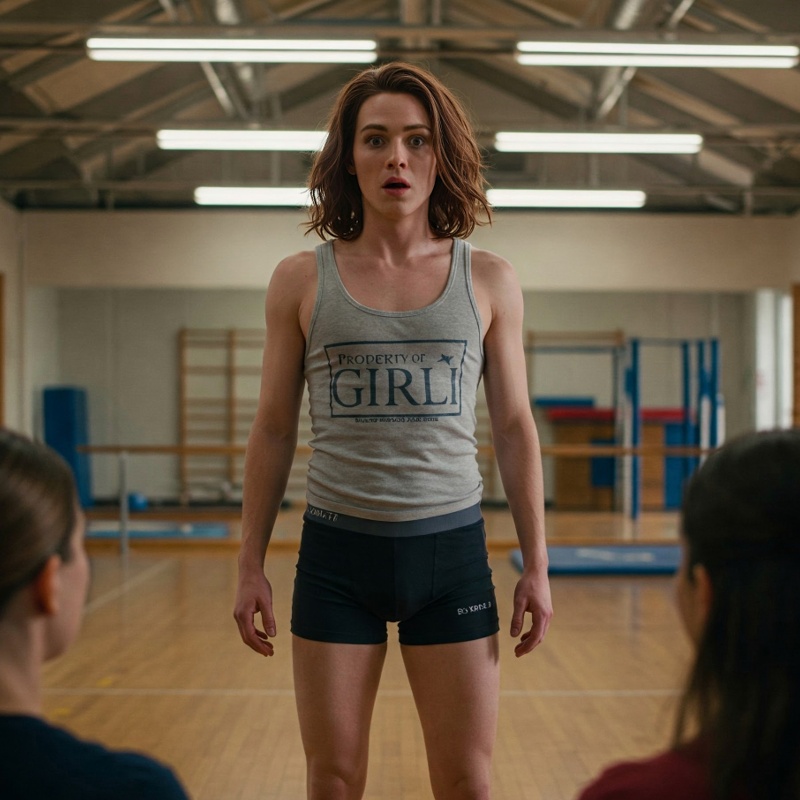
He suddenly found himself at an impossible crossroads, trapped between equally unacceptable alternatives. After months of Dr. Gupta’s treatments, his body had been transformed into an androgynous state that already raised questions about his former identity. His education was over, his football career destroyed, and his future nonexistent outside of this bizarre opportunity.
Coach Winters returned with an enthusiastic smile that seemed to signal his sealed fate. “Good news! The scholarship committee has pre-approved Elle’s placement based on your recommendation, Dr. Gupta. We can begin summer training next week following completion of her biometric registration.”
As Logan stood frozen in the middle of the gymnasium, Coach Winters continued outlining the program details—uniform requirements, summer training schedule, housing arrangements—all directed at “Elle Turner,” the new transfer student joining Westridge Academy’s elite cheerleading program.
The person who had arrived at the GIRLI clinic as Logan Turner, injured college football player with dreams of athletic redemption, now stood at the precipice of an unimaginable transformation—one that had only just begun, but had already progressed too far to easily reverse. The future stretching before him bore no resemblance to anything he had ever imagined for himself, and yet it remained his only path forward in a world that no longer had room for who he used to be.