I knew Beau was done listening when his finger started tapping. Three sharp strikes against the mahogany, pause, repeat.
Tap-tap-tap. Pause. Tap-tap-tap.
It's funny how you can know someone's tells so intimately and still let them destroy you. Seven years of cataloging Governor Beauregard Fenstemaker III's micro-expressions, and here I was, still performing for an audience of one who'd already left the theater.
The finger-tapping meant he was tolerating my existence out of courtesy—that particular brand of old-money politeness that lets you cut someone's throat while asking about their mother. His mind had moved on to whatever rich boys think about when the help gets uppity. Probably yacht maintenance or which intern to fuck next.
I should have recognized the moment for what it was: the beginning of my end. But I hadn't spent a career in politics without buying into its central delusion that you can control things that are already controlling you.
We were seated around the conference table in Beau's office—the same mahogany monstrosity his grandfather had used when governors were still appointed by railroad barons and political machines. Everything in this room screamed inherited power: oil portraits of dead Fenstemakers, windows that perfectly framed the Capitol dome, Persian rugs imported from—well, Persia I guess. I'd worked in this office for seven years and never stopped feeling like the help.
Which, let's be honest, is exactly what I was.
Beau commanded the head of the table with six-foot-two of masculine confidence wrapped in a suit that cost more than my car. Blonde hair perfectly styled, broad shoulders that made expensive fabric look like it naturally belonged on his body, the kind of aristocratic bearing that came from never having to earn anything.
Next to him, I felt every inch the middle-class striver—five-eight in dress shoes, longish dirty blonde hair I cut myself, off-the-rack suits that fit well enough but would never have that custom-tailored drape.
"Our comms team agreed," I said anyway, sliding another document across the table. Polling data I'd spent three days analyzing, reduced to bullet points for a man whose attention span had been ruined by private schools and participation trophies. "We acknowledge the allegations with a statement expressing disappointment in the mischaracterization, then pivot to the infrastructure bill. Keep it measured, controlled—"
"Controlled?" Beau looked up from the numbers showing him eight points down in the party primary to Jenkins—a nobody district attorney who'd discovered that calling rich people corrupt was surprisingly effective politics. "We're hemorrhaging support, Evan. And your response is to issue a statement expressing disappointment?"
He pushed the polling data aside like it was radioactive. Like mathematics itself was somehow beneath him. This is what inherited wealth does to the brain—it calcifies the part responsible for hearing things you didn't want to hear.
The office went silent in that particular way that happens when everyone realizes they're watching a car crash but nobody wants to be the one to call 911. My deputy chief of staff, Casey Parker, caught my eye from across the table.
Casey had been with us since that first campaign, climbing from scheduler to deputy chief with the kind of ruthless efficiency that would have impressed my father. Smart enough to know when to speak and when to watch, politically savvy enough to navigate Beau's ego while keeping actual work moving forward.
In our time working together, I'd learned her every minute expression, every tell that telegraphed to me what she was thinking: the way she'd bite her lower lip when thinking through complex problems, how her voice dropped half an octave when she was really focused, the particular intensity she brought to everything she deemed important.
Casey had stopped typing and quietly closed her laptop about thirty seconds before Beau's outburst—somehow she'd anticipated this explosion before the first harsh word was even spoken. She had an unsettling talent for reading the subtext in every conversation, every glance, every pause.
Our last campaign hookup was years ago. But I still found myself noticing when Casey tucked her dark hair behind her ear before she spoke. She'd cut it shorter since taking the deputy chief role—a sleek bob that framed her face professionally while still managing to be distracting when she leaned forward to review documents. Those same dark eyes that had studied me with calculating interest during our few nights together in 2018 now surgically tracked every political nuance.
We'd both decided those campaign encounters were mistakes—too much adrenaline, too much wine, too much proximity during eighteen-hour strategy sessions that blurred the line between professional partnership and personal connection. Well, she'd decided they were mistakes. I had reluctantly agreed, if we're being honest.
"Fuck that," Beau said, performing his favorite role: the aristocrat who swears like a construction worker to prove he's a man of the people. "We hit back. Hard."
As Beau's voice rose, Casey shifted almost imperceptibly forward in her chair—not enough to draw attention, but positioned like she was ready to intervene if this went beyond professional disagreement. Her pen lay ready beside a yellow legal pad where she'd already drafted what looked like talking points, as if she'd anticipated this confrontation before it even started.
"Governor, respectfully, the focus groups are clear," I said, deploying my negotiation tone—the one my father had perfected during his legendary career as a political operative. James Cross had built his reputation on never backing down and never losing control. I'd spent thirty-four years trying to measure up to a man who'd made the impossible look effortless. "Aggressive denial reads as guilt to the suburban women we need in November."
"Focus groups." Beau spat the words like they tasted of shit. "Tell me, when was the last time a focus group won an election?"
"2018. Your first campaign. When you listened to my strategy instead of your instincts to attack that reporter who questioned your expense reports."
I should have stopped there. Should have recognized that mentioning the first time I'd clearly proven my political instincts surpassed his was like waving a red flag at a bull with daddy issues and an Ivy League education. But I've always had a problem knowing when to shut up—a character flaw that my father would have called "professional suicide" and my therapist would have called "self-sabotage."
Beau stood abruptly, walking to the windows overlooking the Capitol grounds. Outside, a dreary January storm sent sleet against the glass in sharp, irregular strikes. Beau took in the gloom, hands clasped behind his back in a pose that said "thoughtful statesman" but masked "entitled prick having a tantrum."
The Fenstemaker name was literally carved into this building's foundation. Grandfather the governor, father a senator, three generations of public service funded by private wealth and maintained through strategic marriages to other people's money. Beau carried his legacy like armor that made him untouchable. Which was ironic considering how often he got touched by people who weren't his wife.
Not that I had room to judge inherited advantage. My own career had been built on my father's connections and reputation. But I was no dilettante. There was a difference between inheriting political knowledge and inheriting political power.
James Cross had earned his legend through competence and creativity, not trust funds and family crests. I spent every day trying to live up to that standard—and failing miserably, if my father was to be believed. Beau, meanwhile, had never had to earn anything—not respect, not authority, not even basic competence.
"You want to know what these numbers really say?" he asked, still posing for whatever invisible portrait he imagined history was painting. "They say people think I'm weak. That I let the legislature walk all over me. That I compromised too much on the education bill."
"They think you're reasonable," I countered, which was political speak for "they think you're not completely insane yet." "Which is why we need to stay measured. Jenkins is baiting you. He wants you to come out swinging so he can play victim."
"And I'm supposed to just take it?" Beau turned around, and I could see the Fenstemaker arrogance crystallizing into something uglier. "Let him call me corrupt while we wring our hands about optics?"
Looking back, here's where I made my mistake. Instead of reading the room—instead of recognizing that I was dealing with a man whose emotional development had been arrested somewhere around boarding school—I decided to explain feelings to someone who'd never had to consider anyone else's.
"We need to think about how this affects everyone," I said, gesturing around the table like I was conducting a fucking therapy session. "The whole campaign. We can't just consider your feelings—we have to think about what voters will feel when they see you attacking someone half your size."
"Feelings?" Beau's voice rose with the particular indignation of someone who'd never been told he wasn't the most important thing in the room. "You want to talk about feelings?"
I should have backed down. Should have recognized that I'd pushed too far. But I've never been good at strategic retreat. Another character flaw inherited from my father. He'd built his legend on never giving ground.
"Yes, actually. Politics is about emotional connection. About making people comfortable with their choice. About understanding that voters aren't just numbers on a spreadsheet—they're human beings with concerns and fears and—"
"Christ, Evan." Beau's face was flushing the particular shade of red that rich men turn when someone suggests they aren't the center of the universe. "Who the fuck are you, explaining politics to me! Listen to yourself. You're talking like a damn woman! All feelings and sensitivity when what we need is a direct counterattack."
The gendered insult hung in the air like the smell of something rotting. My collar suddenly felt two sizes too tight, sweat gathering at the base of my neck despite the January chill seeping through the windows.
Around the table, my staff performed the elaborate dance of pretending they hadn't heard their boss casually deploy workplace harassment as a management strategy. Communications Director Derek Holt suddenly discovered his notes contained the secrets of the universe. Budget Director Janet Weiss shifted in her chair like she was calculating evacuation routes, her lips thin and white. Even the ancient radiators seemed to pause their steady hissing, as if the building itself was holding its breath.
Casey maintained her usual professional composure, though when Beau made the "damn woman" comment, she caught my eye for just a fraction of a second—a look of solidarity that said she had my back, no matter how ugly this got.
"Gender-based insults," I said, my voice tight with the kind of controlled anger that had made me legendary for staying calm under pressure. "Very gubernatorial."
"It's not an insult if it's true," Beau shot back. "Seven years I've counted on you for real political strategy, and now you're sitting there lecturing me about feelings and sensitivity like some pearl-clutching ninny? You're an embarrassment. To me, to this office, to everything we've built here. And you're sure as hell an embarrassment to your father's legacy."
I held his gaze for a long moment, then turned to the staff. "I think we need the room."
They evacuated like the building was on fire. Chairs scraped against hardwood as the senior staff gathered their materials. Janet closed her laptop with a snap that sounded like a bone breaking. Derek was first to the door, muttering about calls that suddenly needed making.
Casey was the last to rise, and for just a moment, our eyes met. I saw what I'd always seen in her—unwavering support, the expression of someone who'd follow me into whatever political hell was coming next. She hesitated at the door, clearly wanting to stay, but I gave her a small nod. She understood immediately and left, though not before giving me one last look that said she'd be right outside if I needed her.
The door closed with the soft finality of a coffin lid.
"This conversation is over," Beau said, moving toward his desk like a general retreating to his war room.
"Is it?" Something snapped loose inside me—seven years of careful professionalism, of swallowing my pride while managing his crises, of being the adult in a room full of overgrown children playing with other people's lives. "Because we seem to keep having the same conversation. You create a mess, I clean it up, and then you ignore my advice on how to avoid creating the next one."
Beau yanked open his desk drawer with the violence of someone who'd never been taught that furniture wasn't for taking out your feelings on. "You're forgetting your place, Cross."
My place. As if I was still some middle-class kid who should be grateful for the chance to clean up after his betters. As if years of making him look competent hadn't earned me the right to speak truth to power.
"My place is to give you the counsel you need, not what you want to hear," I said, and even as the words left my mouth, I knew I was crossing a line that couldn't be uncrossed. "And what you need to hear is that attacking Jenkins will backfire spectacularly."
"Jesus Christ," Beau barked a laugh that had no humor in it. "You sound like my wife. All this hand-wringing about how things will look, about what people will think. Maybe if you spent less time worrying about everyone's comfort levels and more time on actual strategy—"
"I've spent the last seven years protecting your reputation," I shot back, and now we were in the territory where careers go to die. "Including when I had to work around the clock pushing back on that ridiculous Jenny Lamont story."
Something shifted in Beau's expression. Not guilt, exactly, but a flicker of something I should have paid more attention to.
"Ancient history," he said, but his voice was different now. His hand drifted into his desk drawer, fingers toying with something just outside my line of sight.
"It was four weeks ago! I spent three days personally calling reporters, assuring them you were at the economic conference all weekend. I had to threaten the Tribune with a lawsuit. All while you were supposedly at your lake house reviewing policy briefs."
The truth was, I'd never quite believed his alibi. There had been too many inconsistencies, too many gaps in his timeline. But I'd chosen not to dig deeper because some truths are more dangerous than lies, and my job was to protect him from both.
I should have known better. I should have known that willful ignorance in politics is just another form of complicity. But I'd learned that with Beau, sometimes ignorance of how the sausage got made wound up being necessary to survival.
When the pharmaceutical lobby had tried to kill our prescription drug transparency bill, Beau had simply invited their biggest donor to a private dinner and casually mentioned that his wife's foundation was looking for major contributors. Three days later, the bill passed committee with bipartisan support. Was it ethical? Probably not. Did it save diabetics hundreds of dollars on insulin? Absolutely.
I'd told myself we were using the system's corruption to achieve actual good, playing the game better than the other guys but for the right reasons. But this felt different. This wasn't strategic compromise—this was making me spin to protect his personal failings.
"You did your fucking job," Beau said with the casual cruelty of someone who'd never had to do his own dirty work. "What's your point?"
"My point is that I'm tired of cleaning up messes you could avoid if you'd just listen to someone who understands that politics isn't about what makes you feel powerful—it's about what makes voters feel safe."
"There you go again," Beau said, his voice dripping with the particular contempt that rich men reserve for people who suggest that other people might matter. "Feelings. Understanding. Listen to yourself, Evan!"
His hand emerged from the desk drawer holding something small and pink. He tossed it across the desk, where it landed among the budget reports like a lace-trimmed landmine.
Panties. Women's underwear. Dainty and delicate and absolutely, unmistakably real.
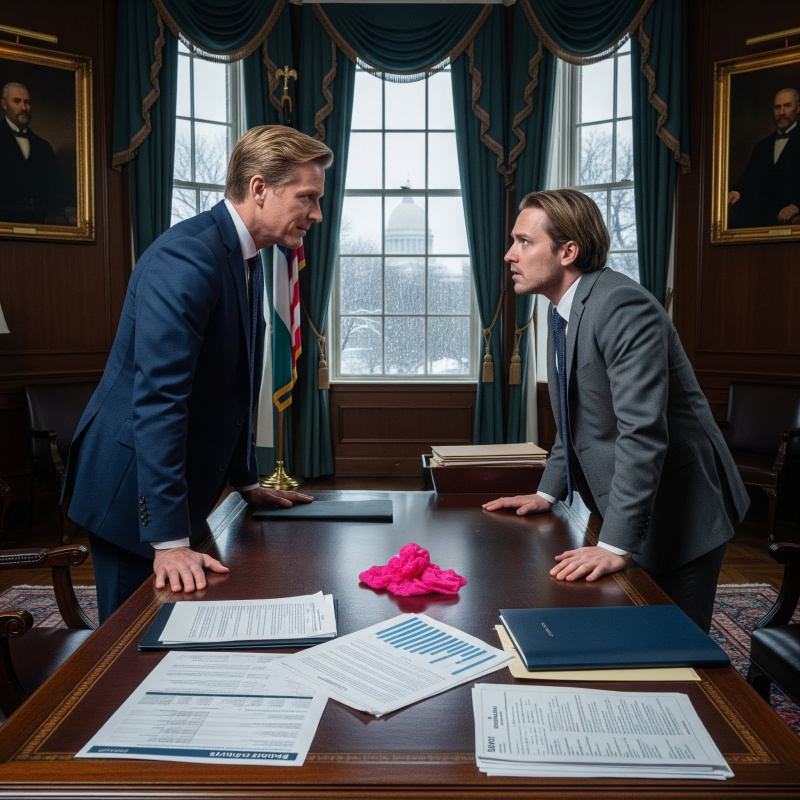
Bright pink with scalloped edges. Exactly like the ones Jenny Lamont had described in exquisite detail to the tabloid reporter—the pair she'd claimed to have left behind at the governor's lake house during a weekend I'd convinced everyone had never happened.
I stared at them, and suddenly all those inconsistencies crystallized into truth. He'd kept them. Like a fucking trophy. The arrogance was breathtaking—keeping evidence of his infidelity in the same desk where he signed executive orders.
"That's right," Beau said, watching my face with the satisfaction of someone finally revealing his trump card. "I fucked her. All weekend. While you were at home crafting your precious statements about how it never happened."
The floor swayed under my feet, like I was on a ship that had just hit rough water. A career of trusting my instincts, of believing I could read situations and people, and I'd been completely blind to something happening right under my nose. How many other lies had I defended? How many times had I stood in front of cameras, staked my professional reputation on his word, while he laughed at my gullibility behind closed doors?
The betrayal hit me like a slap. Not just that he'd lied to me, but that he'd made me lie for him. My father had made me read All the King's Men in high school. "Every political operative needs to understand Willie Stark," he'd said. "So you can recognize him when you're working for him." Looking at Beau now, I wondered how I'd so utterly failed to learn the lesson.
"You made me lie," I said, my voice barely above a whisper. "To multiple reporters. On the record."
"I made you do your job," Beau corrected with breathtaking casualness. "And now your job is to go on offense against Jenkins. Or are you too delicate for that?"
Delicate. Like I was some fragile flower who couldn't handle the rough and tumble of real politics. Like I hadn't spent seven years eating shit so he could look like a statesman.
"I've covered for your affairs, your temper tantrums, your drunken speeches," I said, my voice dropping to the register that had always made my staff nervous. "I've rewritten history so many times for you I should get the fucking Pulitzer. I draw the line at strategies that will sink us in the polls."
"But you know what? This isn't even about strategy anymore," I continued, hearing my voice rise. My hands were trembling slightly—from anger or adrenaline, I couldn't tell. The taste of copper filled my mouth. "It's about basic human decency. About treating people—including your own staff—with a minimum of respect. About considering consequences beyond your own ego."
"Listen to yourself," Beau said with disgust. "Whining about respect and feelings and human decency like some bleeding heart—"
"I'm talking about competent governance—"
"You're talking like a fucking woman! Maybe you want to dress like one too?" Beau gestured to the panties with the casual malice of someone who'd finally found the perfect weapon. "Put these on. Maybe then the message will match the messenger."
The underwear lay between us like a thrown-down gauntlet. My heart hammered against my ribs. The room felt smaller suddenly, the walls pressing in. Sleet pelted against the windows in irregular bursts that matched the blood pounding in my ears.
Tap-tap-tap. Pause. Tap-tap-tap.
I thought of my father—what James Cross would do when faced with this kind of crude power play. He wouldn't have backed down. That much was certain. But he would have found a creative solution. Some way to turn his opponent's strength against him.
The panties lay there, pink and impossible and somehow inevitable. In that moment, I knew what I had to do.
I reached for them, my eyes never leaving Beau's face.
Because I was going to show him what happens when you underestimate the help.
"The PAC wants us to reconsider the guest list for the fundraiser," Casey said without looking up when I appeared in her doorway ten minutes later. She had three different versions of a press statement already drafted on her screen—contingency plans for scenarios I hadn't even considered yet. "Apparently Judge Michaels has been making inappropriate comments again and—"
She stopped mid-sentence, finally registering my expression. Only then did Casey meet my eyes, and I watched her read my face the way she'd been doing for seven years. Today she saw anger, certainly, but beneath it something more complex—a strange mixture of defiance and uncertainty that I wasn't even sure I understood myself.
"What happened?" she asked, setting her pen down with the deliberate calculation she brought to everything.
I closed the door and dropped into the chair across from her desk. Her office was smaller than mine but more personal—photos from campaigns, a plant that somehow survived under fluorescent lighting, books that suggested she actually was interested in the policy behind the politics.
"He told you about Jenny Lamont," Casey said. Not a question.
I stared at her. "How did you—"
"Because Beau's not as good a liar as he thinks he is, and you're not as good at reading people as you think you are." Casey leaned back in her chair, studying me with those dark eyes that never missed a detail. "You look like you saw a ghost, so I'm guessing he had proof? Something physical?"
I nodded slowly.
Casey was quiet for a moment, her political mind working through the implications. This was what I'd always valued about her—the ability to see all the angles in any situation, to understand not just what happened but what it meant.
"What exactly happened after we left?" she asked.
I hesitated. The whole thing felt surreal now, sitting in Casey's normal office discussing normal political problems as if the normal laws of physics still applied.
"He called me weak. Said I was acting like a woman. Then he pulled out a pair of pink underwear—Jenny Lamont's underwear—and told me to put them on."
Casey's eyebrows rose slightly. "Excuse me?"
"The panties she left at his lake house. The ones I swore to six different reporters didn't exist because the weekend never happened."
"Ah," Casey said, understanding dawning in her expression. "And?"
"And I did something... reckless, Case."
Casey studied me for a long moment, her expression readable in the way it only was with me. All our years of working together, including those few intense nights we'd both agreed to forget, had taught her to read my moods. She could tell when I was bluffing with reporters, when I needed coffee before I even realized it myself, when I was about to make a decision that would either save or sink us all.
"Reckless… how?" she asked carefully.
Instead of answering, I held her gaze as I hooked my thumb into my waistband and pulled upward.
Bright pink lace with a delicate scalloped edge rose into view.